QR Code vs NFC Tag vs Short Link: Which One Should You Actually Print?
QR codes, NFC tags and short links compared on cost, range, reach, visibility and tracking, with a placement-by-placement guide to choosing and combining them.
Every year someone declares that NFC will replace QR codes, or that QR codes already have. Neither has happened, because they solve slightly different problems. Meanwhile a third option, the humble short link, quietly outperforms both in places neither can reach.
This post compares the three honestly and ends with a way to choose by placement rather than by fashion.
The same job done three ways
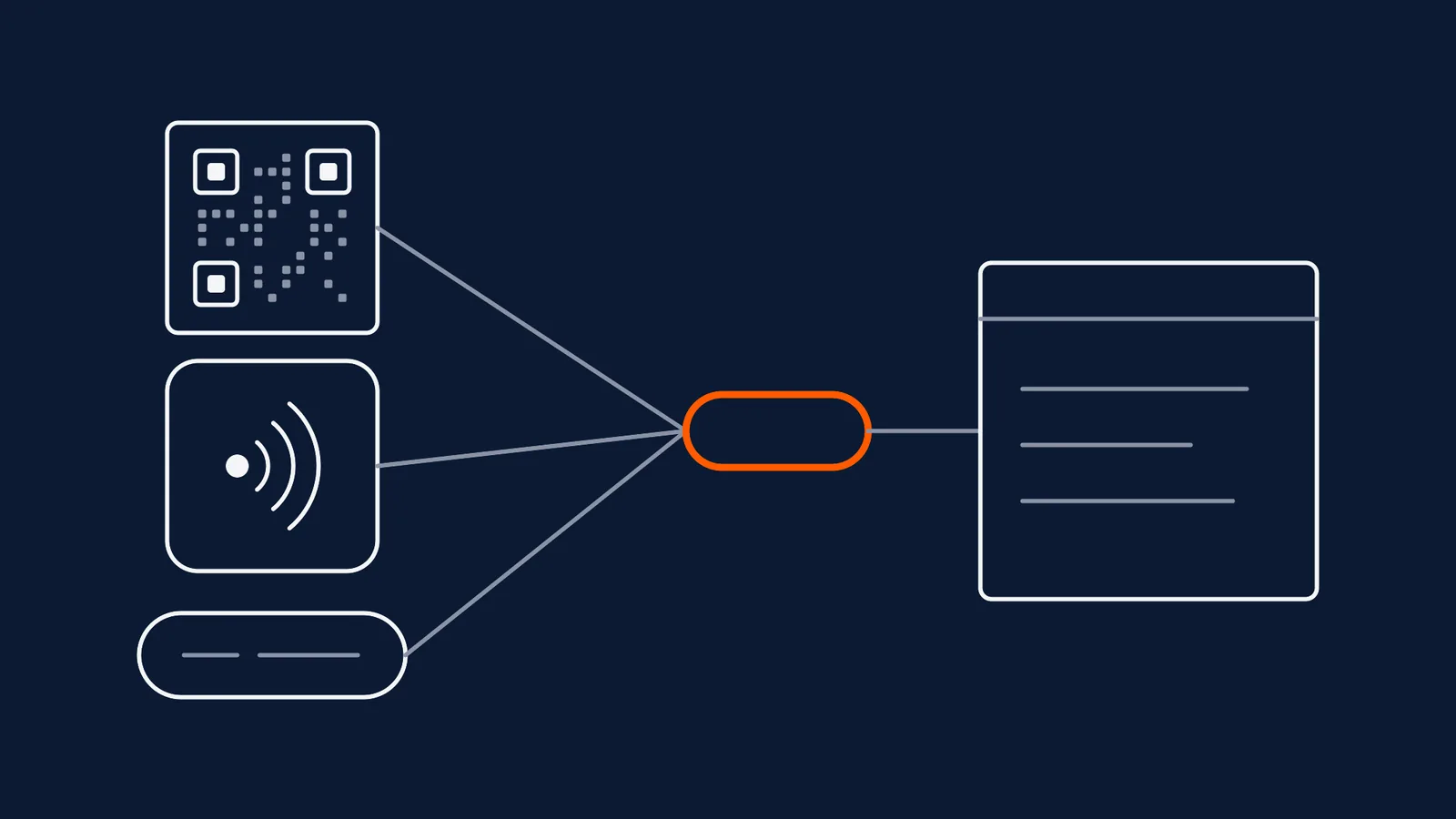
All three are carriers for an address. The question is how a person gets from the thing in front of them to the page.
- QR code: point a camera at a pattern.
- NFC tag: hold a phone against a small embedded chip.
- Short link: read or hear an address and type it.
The comparison
The figures below come from a vendor comparison published in 2026, which is a vendor's own estimate and not an independent test. The structure holds even where the numbers will not.
| QR code | NFC tag | Short link | |
|---|---|---|---|
| Cost per placement | Close to nothing to print | Roughly $0.10 to $0.50 per tag at volume, per one vendor | Nothing |
| How the person reaches it | Camera, from a distance | Phone held within a few centimetres | Reads or hears it, then types |
| Devices | Any phone with a camera | Needs a phone with NFC, switched on | Any device with a browser |
| Visible to the eye | Must be seen to be scanned | Can be hidden in an object or under a sticker | Must be read or heard |
| Works at a distance | Yes, sized by the 10:1 rule | No | Yes, if audible or legible |
| Built-in analytics | None; needs a tracked link | None; needs a tracked link | None; needs a tracked link |
| Durability | Can fade, scuff or tear | Better against weather, though adhesive can fail | Nothing to wear out |
| Replaceable by an attacker | Yes, with an overlay | Yes, though a tag can be locked read-only | Not applicable, but a lookalike address can be bought |
Two rows carry most of the decision: reach and cost at scale. A QR code is the only one of the three that works at any distance a camera can handle and costs nothing per copy. A tag works only up close and costs money every time you place one.
Where each one wins
QR code wins wherever people are at a distance, in a hurry or in a crowd: posters, shop windows, shelf-talkers, packaging, flyers, hoardings. It is also the only one that works on paper and cardboard at scale without any additional hardware. Placement and size still decide whether it works.
NFC tag wins where the interaction is close, deliberate and repeated, and where you want the surface to look clean: a table-top stand, a product demo unit, a hotel room card, a trade-show badge, a smart poster at arm's length. A tag can sit under a printed graphic, so the surface carries a clear invitation without a visible square.
Short link wins wherever nobody can scan or tap: a radio spot, a voice-over, a spoken pitch, an event stage where the audience is too far away, or a screen they will remember rather than photograph. It is also the best printed fallback next to any code, for people who will not or cannot scan.
A placement-by-placement guide
| Placement | Best primary choice | Add alongside |
|---|---|---|
| Poster, hoarding, flyer | QR code | A short link as text |
| Shop window | QR code, sized for distance | Short link as text |
| Product packaging | QR code | None needed, see packaging rules |
| Counter or table stand | QR code, or NFC for a clean look | The other, on the same link |
| Business card | QR code | NFC card only if the budget allows |
| Hotel room, demo unit | NFC tag | QR code as backup for phones without NFC |
| Radio, podcast, voice-over | Short link | None possible |
| Stage slide | Short link, spoken and displayed | QR code on a handout |
| Outdoor, rough surface | QR code at higher error correction | Short link as text |
The best answer is often 'all three, one link'
Because each carrier simply holds an address, you can point all of them at the same one and let a single short link do the measuring. A table stand can carry a QR code, an NFC tag and a printed short link, all resolving to the same page. If that address is a dynamic short link, you also get:
- One place to change the destination for every carrier at once, without reprinting any of them. That is the point of editing after print.
- One place to read visits. The redirect records each visit the same way regardless of how the person arrived. A QR scan and an NFC tap will look alike unless you give each carrier its own link, so if you want to compare them, create a separate short link for each.
- A fallback for every phone. Someone with NFC off can scan; someone without a camera app can type.
The usual caveat applies. A dynamic link depends on a platform staying up and staying yours, and that applies to every carrier at once. Putting everything behind one link makes the dependency bigger, not smaller, so choose the platform as carefully as you choose the format.
Measuring across carriers
None of the three carries analytics by itself. As the vendor comparison also notes, both QR codes and NFC tags can point at a tracked short link, so measurement works the same way for each. Give each placement and each carrier its own link, tag them with consistent UTM parameters, and you can read which placement and which format earned each visit. Without that, you have a total and no story. The usual limits on what you can read from scan data apply to every carrier equally.
What none of them fixes
- Nobody knows why they should engage. A tag with no instruction is as silent as a code with none. A clear line beats the format.
- Tampering. Both tags and codes can be covered or replaced, so the physical-audit habit applies to both. A tag can be locked against rewriting, which a code cannot, but a sticker over either defeats the lock.
- A dead destination. The page behind the carrier must work on a phone, on a real connection.
What this means for your next campaign
Start from the placement, not the technology. If people will be at a distance, in a crowd or holding paper, print a QR code and a short link in text. If the interaction is close and repeated and you want a clean surface, add an NFC tag and point it at the same link. If nobody can scan or tap, give them an address they can say aloud. Then put one tracked link behind all of it, tag it consistently and run the pre-print checklist before anything is made in quantity.
Straight answers
Is NFC better than a QR code?
Neither is better in general. A QR code can be scanned from a distance by any phone with a camera and costs almost nothing to print. An NFC tag needs the phone to be held very close, needs a phone with NFC switched on and costs something per tag, but it can be hidden inside an object and needs no framing. The right choice depends on where it will sit and who will be touching it.
Can an NFC tag and a QR code point to the same place?
Yes, and it is often the best arrangement. Both can hold the same web address, so a printed code and a tag on the same display send people to the same page. If that address is a short link you control, you can change the destination for both at once and see visits from either in the same place, though you should check how your platform labels tag taps versus code scans.
Do NFC tags have built-in analytics?
Not by themselves. A tag simply stores data, usually a web address. Any measurement comes from what the address points to, in the same way as with a QR code, so both depend on a tracked link in the middle to tell you anything at all. If you want numbers, the address has to be one that records visits.
When is a plain short link the better choice?
When nobody can scan or tap: on a radio spot, in a speech, in a video voice-over, on a stage slide that will be read aloud, or on a screen people will remember rather than photograph. A short, spellable address is the only option that works with no camera and no phone proximity. It is also a sensible printed fallback beside any code.
-
Vendor blog: tag cost range, tap distance, device support, tracking, durability, security; specifics treated as vendor-reported
https://scanapp.org/blog/2026/06/08/nfc-vs-qr-codes-which-should-you-use.html