QR Codes at Events: Booth, Badge, Standee and Stage
Size and height rules for booth, badge, standee and stage QR codes, and the honest case for a spoken short link over a stage-slide QR code.
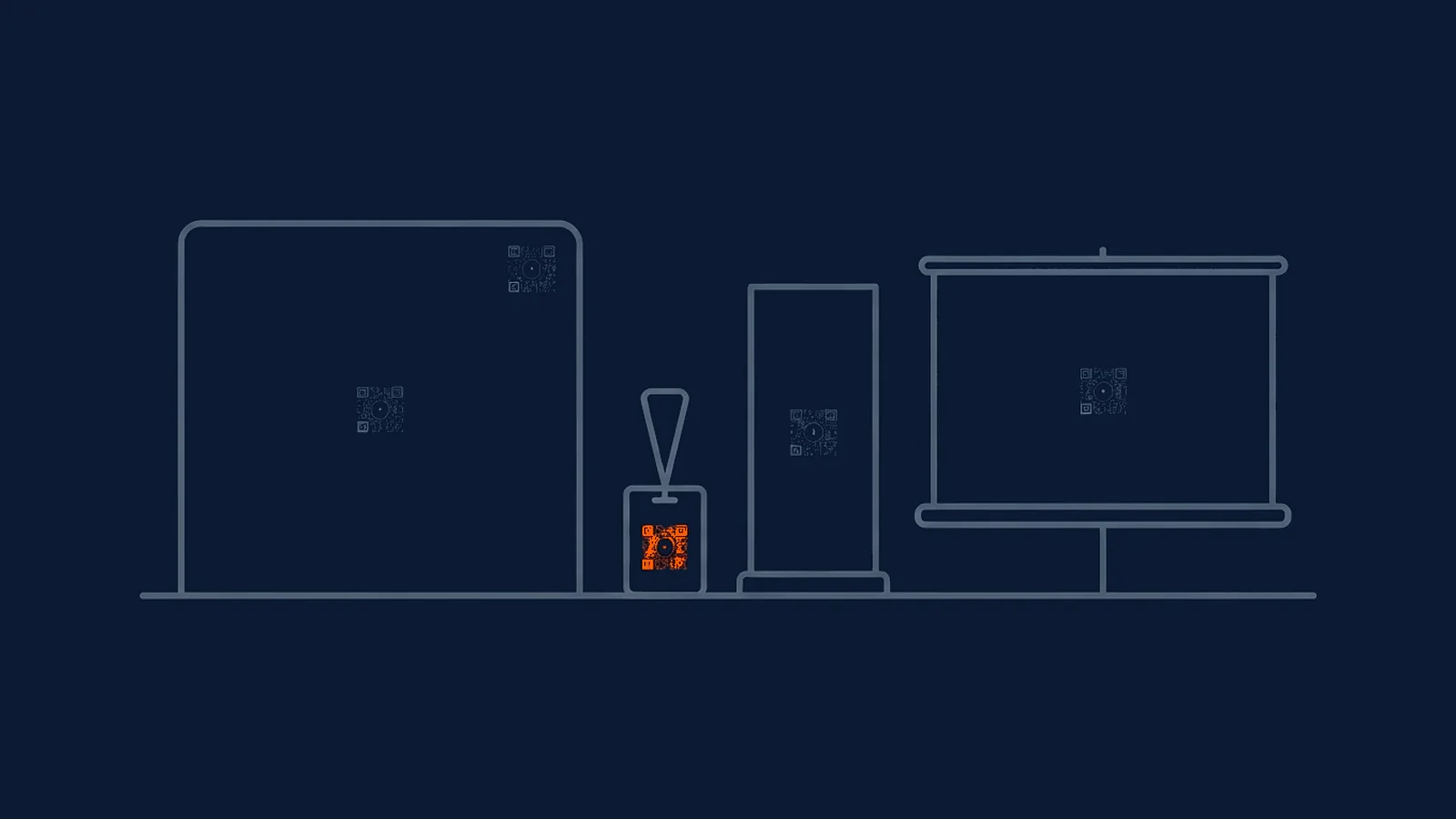
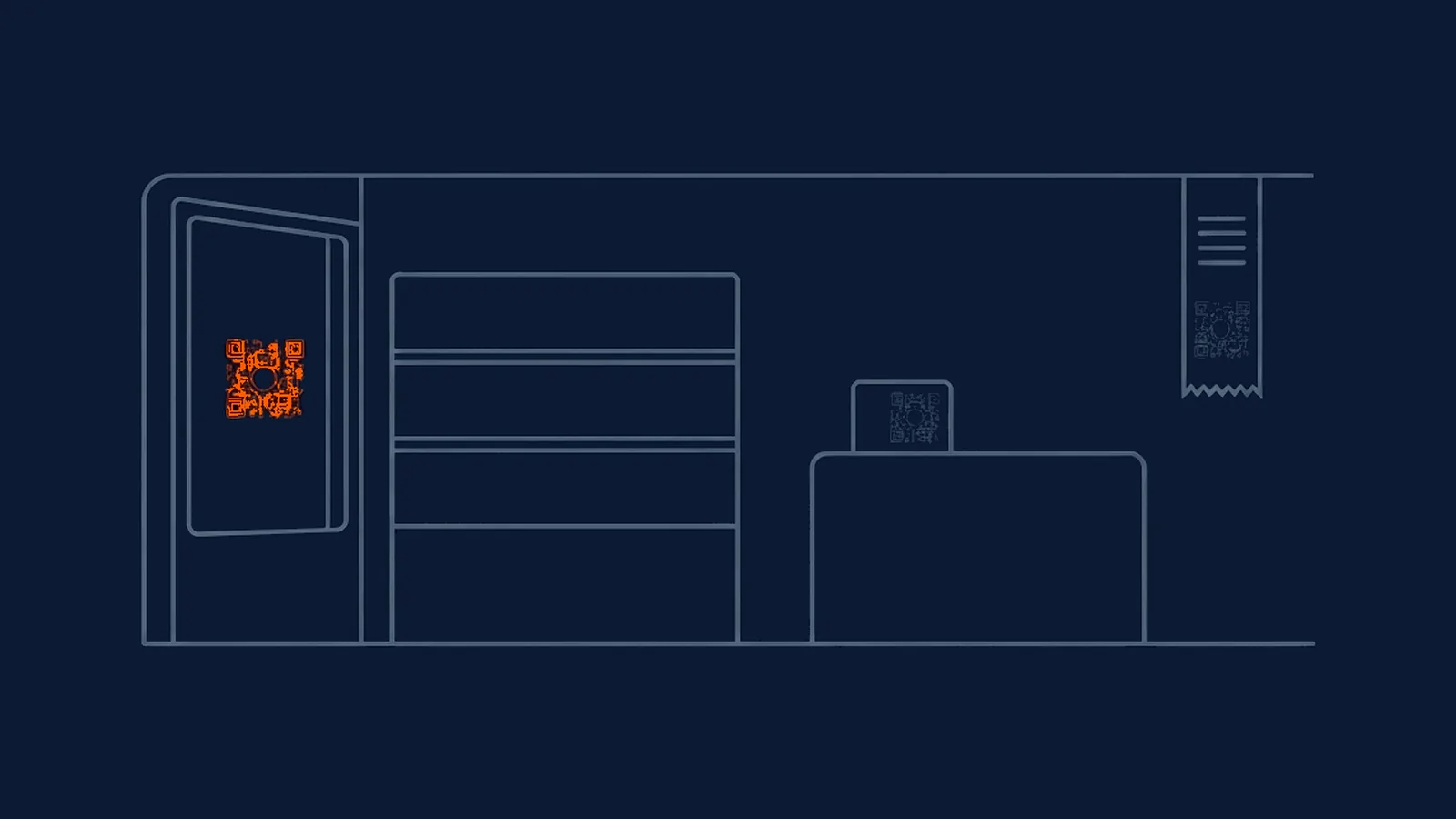
An event compresses four different QR use cases into one room, sometimes one hour: a badge worn at chest height, a booth sign meant to be seen from the aisle, a standee anchoring a specific spot, and a stage slide seen briefly from the back row. Treating all four the same way, one code, one size, printed once and reused everywhere, wastes the one advantage an event actually offers a QR code: a captive, physically present audience worth measuring surface by surface.
Four surfaces, four different jobs
| Surface | Typical viewing distance | Minimum size (10:1 rule) | What it's actually for |
|---|---|---|---|
| Event badge | 20-40 cm, close and brief | 2-4 cm | Lead capture and identity exchange, one to one |
| Booth signage | 1-2 m from the aisle | 10-20 cm | Drawing a passerby into a conversation or a resource |
| Standee | 1-1.5 m, someone stopped in front of it | 10-15 cm | A single, specific action tied to that exact spot |
| Stage slide | 5-15 m, from anywhere in the room | 50 cm or more, often impractical | Rarely the right tool; see below |
Sizing across all four follows the same underlying principle already established for placement generally: roughly a tenth of the realistic scanning distance. What changes at an event is how compressed and varied those distances are within a single room, often within a few metres of each other, which is exactly why one code sized for one surface tends to fail badly on another.
Height matters here as much as size, and an event venue makes the eye-level rule harder to apply consistently than a fixed retail fixture does. A badge moves with the person wearing it, tilting and turning as they walk and talk, so its code needs stronger contrast and a slightly more forgiving size than the same distance would suggest for a fixed sign, to compensate for a target that won't hold still. A booth sign or standee, by contrast, is fixed and can be positioned deliberately at standing eye level, roughly 140 to 170 cm from the floor, the same rule that governs any static placement, but crowded booth environments often see this rule ignored in favour of squeezing a sign wherever space allows, which quietly undermines a size calculation that assumed a clear sightline.
Managing the badge's particular constraints
A badge carries the tightest scanning distance of the four surfaces and the least stable orientation, since it moves with a person rather than sitting fixed on a wall or a standee. Lanyard glare under venue lighting, a badge holder's plastic sleeve adding an extra reflective layer, and the badge simply facing away from whoever wants to scan it are all common, avoidable failure points that have nothing to do with the code's underlying design. A slightly larger code than the strict 10:1 minimum, a matte badge holder rather than a glossy one, and a design that keeps the code near the top of the badge where it naturally faces outward when worn all help offset a surface that was never going to hold as still as a printed sign.
The stage-slide problem, stated honestly
A code on a stage slide faces three compounding problems no design choice fixes. Distance is the first: a room seats people anywhere from the front row to fifteen metres back, and a code sized to be scannable from the back row is often large enough to look absurd, or genuinely doesn't fit, on a normally proportioned slide. Time is the second: a slide with a QR code on it typically stays up for less time than a comfortable scan requires, ten seconds or so, during a talk that's still moving, not a static poster someone can return to. Network capacity is the third, and the one most easily overlooked: a room full of attendees scanning the same code within the same short window all hit venue WiFi or cellular capacity at the same moment, and conference venues are notorious for both being saturated well before that peak arrives.
None of these problems are solved by a bigger code, better colours, or a clearer call-to-action. They're structural to the setting, which is why the honest conclusion here runs against the instinct to add a QR code to every slide by default: a short, memorable link, read aloud by the speaker and displayed as plain text rather than a scannable pattern, often outperforms a QR code in this exact setting. Typing a short URL doesn't depend on distance, doesn't compete for a ten-second window the way locating and holding a camera steady does, and doesn't ask a shared, congested network to handle hundreds of simultaneous redirect requests at once. A well-chosen short link is sometimes the better tool specifically because it asks less of the room than a QR code does.
One code per surface, without exception
The instinct to reuse one code across a booth, a badge insert, and a standee is understandable, since it's one less thing to produce and manage. It's also the single fastest way to make an event's data useless afterwards. A shared code merges every surface's scans into one number, with no way to tell whether the standee by the entrance or the sign at the back of the booth actually earned the attention. UTM parameters carrying the specific placement in utm_content, applied per surface even within a single event, are what let a post-event report say which physical spot in the booth actually worked, rather than reporting one undifferentiated total for the whole footprint.
Where two versions of the same booth layout, or two competing standee designs, are being tested against each other, the same one-code-per-surface discipline is also the foundation any A/B test at an event needs to produce a result that means anything.
vCard codes for lead capture
A badge or a business-card-style handout is the one place at most events where a vCard QR code genuinely earns its place, since the entire point of the interaction is exchanging contact details quickly, without either side typing anything into a phone while mid-conversation. A vCard code encodes contact information directly into the pattern itself, so scanning it saves a contact card immediately, with no redirect, no landing page, and no dependency on the venue's network at all.
That last point matters more at an event than almost anywhere else this format gets used. A vCard exchange happening in a crowded hall with saturated WiFi still works, because nothing about reading a vCard code depends on connectivity succeeding at that moment. A dynamic code pointing to a profile page or a booth resource, by contrast, only completes the scan if the redirect it depends on can actually resolve, which is precisely the condition an event's own network conditions put under the most strain.
What happens when connectivity fails
Worth stating plainly rather than discovering mid-event: a dynamic QR code decodes entirely offline, since reading the printed pattern and extracting the short redirect URL from it requires no network at all. What needs a working connection is the next step, the actual redirect to the final destination, and that step fails if venue WiFi or cellular signal is genuinely unavailable at the moment someone scans. For any placement where connectivity at the point of scanning is a real risk, a stage slide in a basement conference room, a badge station in a signal-dead corner of a venue, weighing a static option, a vCard, a WiFi credential, plain contact text, against a dynamic destination is worth doing deliberately rather than assuming the network will simply be there when it's needed.
Large venues compound this in a way smaller ones don't. A hotel ballroom or convention hall built decades before mobile-first design was a design criterion can have patchy indoor cellular coverage even before hundreds of attendees start competing for it, and basement-level breakout rooms are frequently the worst-served part of any venue's network. Scouting a room's actual signal strength ahead of a session, not assuming a booked venue automatically has adequate coverage, is a five-minute check worth doing before a session's entire call-to-action depends on a redirect resolving in that specific room.
What this means for your next campaign
Size each of the four common event surfaces to its own realistic viewing distance rather than reusing one size everywhere. Reconsider the stage slide specifically: a spoken, typed short link frequently beats a QR code in that exact setting, for reasons no design change fixes. Give every surface its own code and its own placement tag, even within a single event, so the report afterwards can say which spot actually worked. Reserve vCard codes for genuine one-to-one contact exchange, where their independence from the network is a real advantage rather than an incidental one. And treat any placement in a connectivity-uncertain part of the venue as a candidate for a static, network-independent format rather than assuming the redirect will simply work when it's needed.
Straight answers
Is a QR code on a conference stage slide worth using?
Rarely, and it's worth saying so plainly. A stage-slide code is scanned from several metres away, in a room with hundreds of phones competing for constrained venue WiFi, in the ten or so seconds a slide stays up. A short link the speaker reads aloud, typed rather than scanned, often outperforms a QR code here, since it doesn't depend on distance or network capacity at the exact moment everyone else in the room is trying to use both.
What size should a QR code be on event booth signage?
Large enough for the realistic viewing distance at that specific spot, using the same size-to-distance ratio that governs any QR placement: roughly a tenth of the scanning distance. A code meant to be read from one to two metres away, typical for booth signage, needs to be in the region of 10 to 20 cm across, not the smaller size that would suit a handout or a business card at arm's length.
Should every surface at an event use the same QR code?
No. A badge, a booth sign, a standee and a stage slide each attract a different scan behaviour and deserve their own code, even when they all lead to the same eventual destination. One shared code across every surface merges the data from all of them into a single number with no way to tell which surface actually earned the scan, which defeats the point of measuring an event in the first place.
What happens to a dynamic QR code if event WiFi or mobile signal fails?
The code still decodes, since reading the pattern itself is entirely offline, but the redirect it depends on needs a working connection to resolve, so a scan attempted during a genuine connectivity failure will fail at that final step. A vCard code is the one common event use case immune to this, since contact details are saved directly from the code itself with no network round trip required at all.